
Alumni
PhD 2015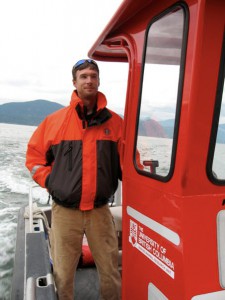
Tel: 604.822.8181
E-mail: a.thomas@oceans.ubc.ca
Education:
MSc – Marine and Estuarine Sciences
Research Interests:
- Animal telemetry and the spatial ecology of top predators.
- Development of molecular tools for the detection and quantification of trophic interactions in marine food webs.
Ecosystem: The Salish Sea
Foraging behaviour and prey consumption of harbour seals (Phoca vitulina) in the Salish Sea
Problem
For over a century harbour seals have been perceived to compete with fisheries for economically valuable fish resources. This perception resulted in a population management strategy in both British Columbia and Washington that substantially reduced the number of harbour seals in the region’s inland waters (The Salish Sea). Since their protection in the early 1970’s, harbour seal populations in the Salish Sea have rebounded vigorously and are once again under scrutiny for their consumption of valuable fish stocks, some of which are ESA/SARA listed species. 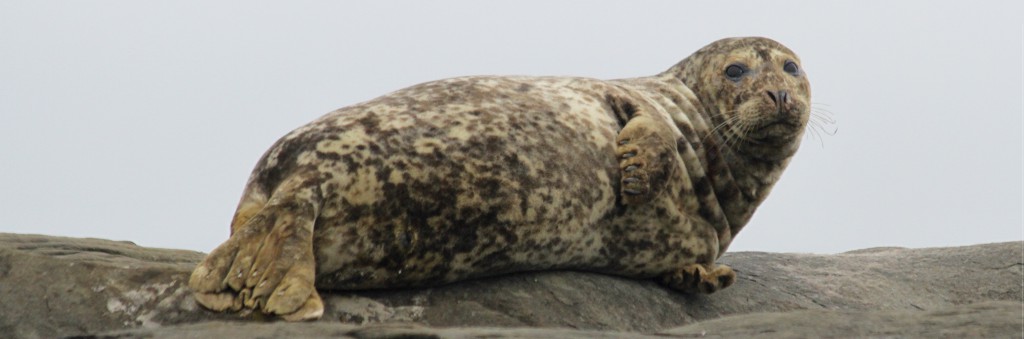
Research direction
My work is focused on refining estimates of harbour seal prey consumption using a combination of newly available technologies. The ultimate goal of this work is to provide resource managers with the best possible marine ecosystem data with which to make informed management decisions. This work is funded by the Pacific Salmon Foundation, and is part of the Salish Sea Marine Survival Project.
Ongoing Projects
Development of the RFID satellite tag
Many have speculated that harbour seals may be responsible for the poor marine survival of Chinook and Coho in the Salish Sea because of their capacity to consume large numbers of juvenile salmon. However, current methods for quantifying that predation rate rely on assumptions that are difficult to validate, leading to considerable uncertainty in the available predation estimates.
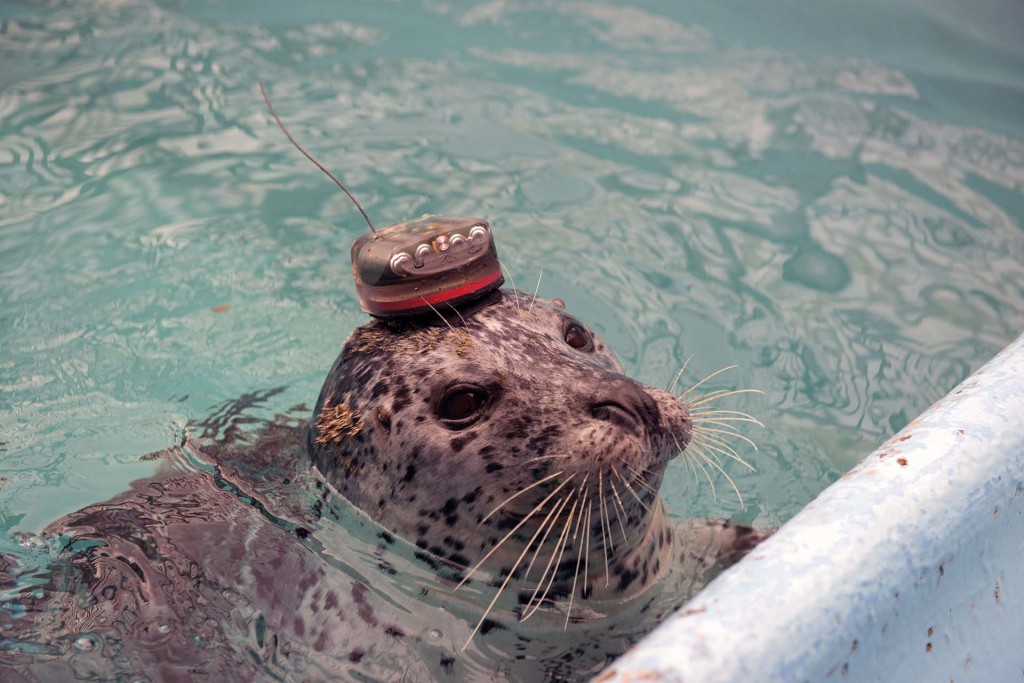
I am currently working with Wildlife Computers and the Vancouver Aquarium on a solution to this problem. We are developing a satellite-linked, head-mounted PIT tag scanner for seals and sea lions that is capable of detecting each time a seal consumes a salmon smolt with a PIT tag. Using this instrument we will drastically improve our estimates of seal predation rates on salmonids, and address a major concern of fisheries managers. For more information please see our article in the Pacific Salmon Foundation magazine.
DNA based diet estimation
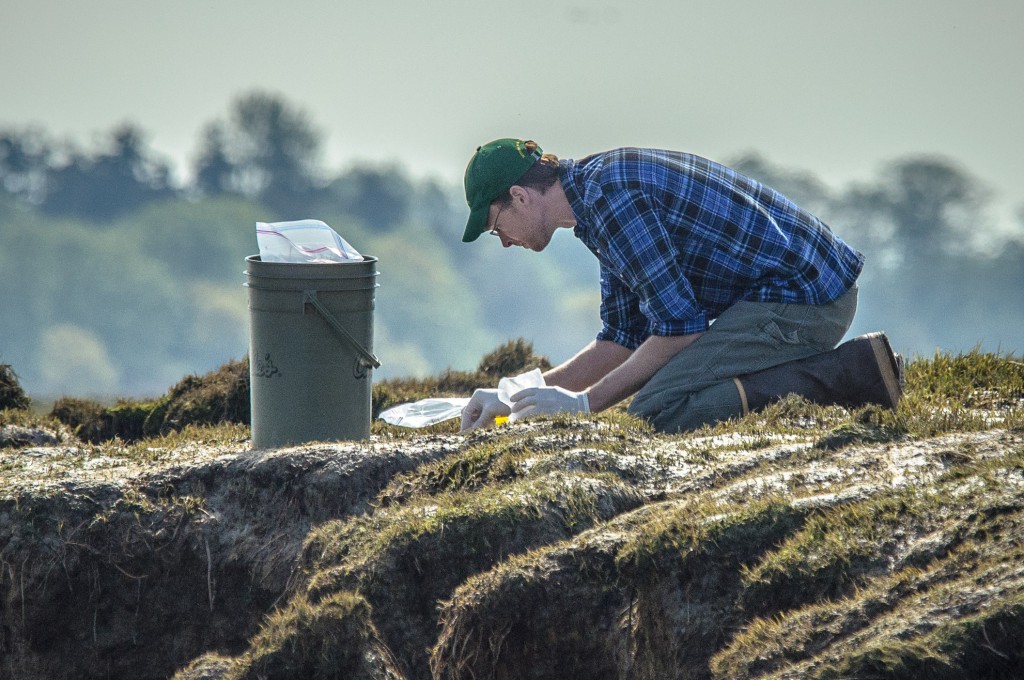
Harbour seal scat collecting
To better estimate harbour seal salmon consumption rates, I am developing with collaborators a new dietary analysis technique to simultaneously identify and quantify the salmonid prey of harbour seals using high-throughput DNA sequencing technology. I employ a combination of prey bone identification and genetic analysis to quantify the age class, species, and proportion of salmon in the harbour seal diet. These novel techniques are currently being applied to seal scats collected from three major salmon estuaries in the Strait of Georgia.For more information about this project please see our newsletter article.
This work has resulted in two recent publications: 1) Evaluation of DNA diet estimate biases; 2) Correcting for biases in metabarcoding diet studies.
Previous work in the region
My masters work at Western Washington University focused on harbour seal use of seasonally available herring resources. I combined seal diet data and GPS telemetry to understand the importance of herring spawning aggregations for harbour seals in the Salish Sea. Click here to see the publication of this work.
Click on the image below to see how harbour seals forage in 3D! This video represents one month of foraging movements of a satellite tagged harbour seal from Protection Island, Washington.
https://www.youtube.com/watch?v=sTr3pjbjXXUhttps://www.youtube.com/watch?v=sTr3pjbjXXU
Publications:
- Thomas AC, Jarman SN, Haman KH, Trites AW, Deagle BE (2013) Improving accuracy of DNA diet estimates using food tissue control materials and an evaluation of proxies for digestion bias. Molecular Ecology: Early View article.
- Deagle BE, Thomas AC, Shaffer AK, Trites AW, Jarman SN (2013) Quantifying sequence proportions in a DNA-based diet study using Ion Torrent amplicon sequencing: which counts count? Molecular ecology resources 13: 620-633.
- Gaydos JK, Ignacio Vilchis L, Lance MM, Jeffries SJ, Thomas AC, Greenwood V, Harner P, Ziccardi MH (2012) Postrelease movement of rehabilitated harbor seal (Phoca vitulina richardii) pups compared with cohort-matched wild seal pups. Marine Mammal Science
- Haman KH, Norton TW, Thomas AC, Nemeth N, Keel K (2013) Mortality events in Great Shearwaters (Puffinus gravis) along the east coast of the United States. Journal of Wildlife Diseases 49: 235-245.
- Haman K, Norton T, Thomas AC, Dove A, Tseng F (2012) Baseline health parameters and species comparisons among free-ranging Atlantic sharpnose (Rhizoprionodon terraenovae), bonnethead (Sphyrna tiburo), and spiny dogfish (Squalus acanthias) sharks in Georgia, Florida, and Washington, USA. Journal of Wildlife Diseases 48:295
- Thomas AC, Lance MM, Jeffries SJ, Miner BG, Acevedo-Gutiérrez A (2011) Harbor seal foraging response to a seasonal resource pulse, spawning Pacific herring. Marine ecology progress series 441:225-239
- Thomas AC (2010) The behavioral response of Harbor seals to seasonal prey pulses of spawning Pacific herring. M.S. Thesis, Western Washington University.
 |
 |
 |
 |